I just published version 4.18 of Antragsgrün, the open-source system that lets NGOs, political parties and social initiatives discuss resolutions, party platforms and amendments together.
After the more infrastructure-focused 4.17 release, this version brings several major new features and improvements.
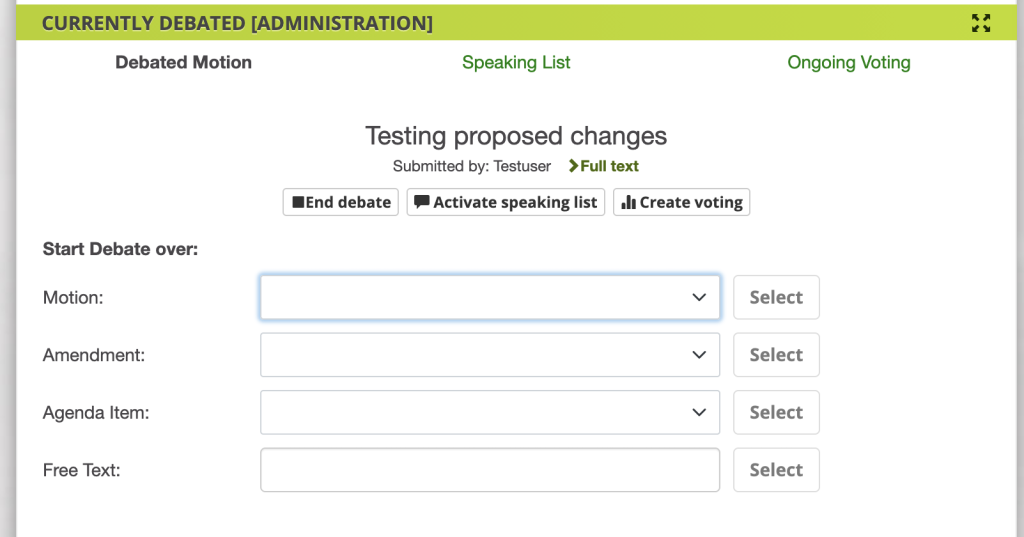
Real-time debates on site: A new „Currently Debated“ widget on the home page helps run the debate at a meeting. It shows which motion, amendment or agenda item is being debated right now, and it brings together the existing speaking lists and votings, which makes running the meeting a lot easier. The voting system was refactored for better scalability: like the speaking lists, it can now optionally use the real-time Live-Proxy. More work on this widget is planned for future releases – in particular ironing out some of the still rough edges, as well as introducing new feature (like raising secondary motions).
Antragsgrün now officially supports multilingual consultations, where a motion and its amendments are submitted in several languages in parallel. This idea came up several times in the past, e.g. by organizations in multilingual countries such as Canada or Switzerland. A consultation can be set up in several languages. Users can then choose their preferred language for the user interface, and each motion holds its text in every language. To help with translation, Antragsgrün also provides a plugin interface for machine-translation services, including a proof of concept that uses the Anthropic API.
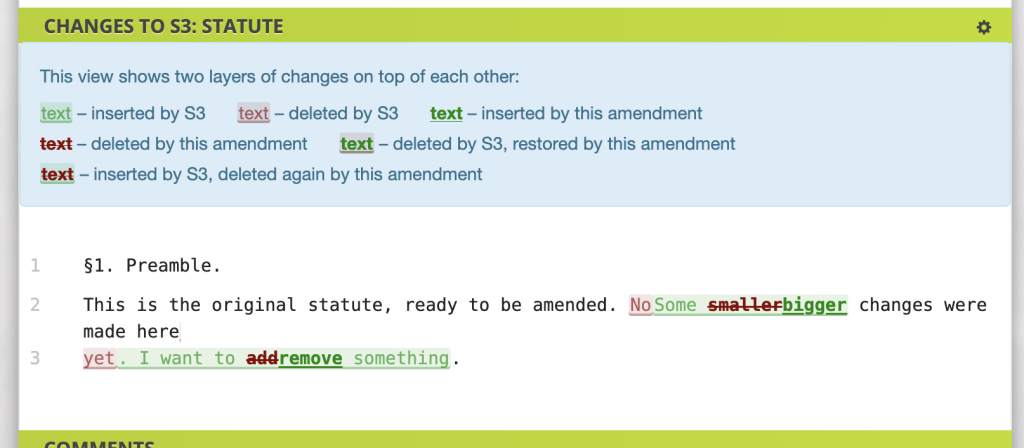
Amendments to statute amendments. Another advanced feature is improved support for statute amendments – and especially for amendments to them. Procedurally, a statute amendment is a motion of its own and is listed as one, but its text is shown as a diff against the current statutes. An amendment to a statute amendment is therefore a second-degree amendment: it changes what the statute amendment proposes to change. Antragsgrün now handles this in two ways. First, these second-degree amendments now correctly appear as amendments in the motion list and the admin list, which is what they are procedurally. Second, a new diff view shows both layers of changes on top of each other, so it is clear which changes come from the original amendment and which are newly proposed. The concept is complex, but the new view should make it much easier to follow.
Finally, a more technical change: the REST API becomes more capable. It now supports authenticated write access using JWTs, most notably for submitting and supporting motions. All operations of the „Currently Debated“ widget, the votings and the speaking lists are also available through the API. The full list of supported operations is documented in an OpenAPI specification, and future releases will add more.
This release also includes many smaller improvements:
- Initial support for Spanish and Swedish
- Supporting motions and amendments on behalf of an organization
- Screening that can be configured per motion type
- Further accessibility work towards WCAG AA compliance
- A new „Amendments side by side“ PDF export
- Several bugfixes, for example around the proposed procedures
The full list is in the Changelog. You can download the new version from GitHub, or get it from Docker Hub and the GitHub Container Registry.